Strength Training After 40: What You Need to Know
Strength training after 40 is about much more than burning calories. At this stage of life, building and maintaining muscle can affect your strength, mobility, body composition, and what your body is capable of doing years from now.
There comes a point where exercise has to stop being about how many calories you can burn in an hour. For a lot of people, that shift happens somewhere in their 40s.
You may still want to lose weight, look leaner, or feel better in your clothes. There is nothing wrong with any of that. But there is a bigger question worth asking: What do you want your body to still be able to do 10, 20, or 30 years from now?
That is where strength training starts to matter in a very different way.
At Physiques Gym in Phoenix, we work with adults at virtually every level, from people stepping into a gym for the first time to experienced athletes and competitive bodybuilders. One thing we see over and over again is that people often come in thinking they simply need to work harder. More cardio. More exercises. More days in the gym. More sweat.
But more is not always the answer. Sometimes you need a better plan. That is one of the biggest differences between simply exercising and actually training.
Strength Training After 40 Is About More Than Looking Muscular
A lot of people still hear “weight training” and immediately picture bodybuilding. We understand why. Physiques Gym has deep roots in bodybuilding and physique competition.
But strength training is not reserved for bodybuilders, competitive athletes, or people trying to build large amounts of muscle. It is simply a way of asking your muscles to work against resistance, whether that resistance comes from dumbbells, barbells, machines, cables, bands, or even your own body weight.
The bigger point is this: your muscles need a reason to stay strong.
If you consistently challenge them, your body has a reason to maintain or build strength. If you stop challenging them, strength and muscle can gradually decline. That matters at any age, but after 40 it becomes something we believe people should pay much more attention to.
Why Muscle Matters More As You Get Older
Muscle does a lot more than make your arms or legs look defined. You use muscle every time you stand up from a chair, carry groceries, climb stairs, lift a suitcase, bend down and get back up, or catch yourself when you stumble.
These things feel automatic when we are younger. Our goal is to help keep them that way.
At Physiques Gym, this is one of the reasons we do not look at strength training as something you do only for appearance. Muscle is part of your independence.
The stronger and more capable you remain, the more options you have as you get older. You can travel, hike, play with your kids or grandkids, carry your own luggage, get up off the floor, and keep doing the things you enjoy without constantly wondering whether your body can handle them.
That matters much more than the number of calories a workout burns.
We See the Difference Between Exercise and Training Every Day
Someone can exercise for years without really progressing. They may come into a gym, move from machine to machine, do a few sets, get sweaty, and go home.
Technically, they exercised. But did they actually improve?
At Physiques Gym, we look at training differently. We want to know what you are trying to accomplish, what you can do well right now, where your weaknesses are, what movements need improvement, what needs to get stronger, and what should progress next.
That is training.
Random workouts can make you tired. A good training program should make you better.
That distinction becomes even more important as you get older because your time and recovery matter. We do not want you spending hours in the gym just for the sake of saying you worked out. We want the work to have a purpose.
You Don’t Have to Wait Until You Feel Weak to Start
One of the biggest mistakes people make is waiting until something starts feeling difficult before they think about strength.
The stairs become harder. Getting off the floor starts taking effort. Balance does not feel as good. Something that used to feel easy suddenly feels heavy.
But you do not have to wait for those signals.
Your 40s are actually a great time to start thinking ahead. You are not training only for how you look next summer. You are also training for the version of yourself who will be 50, 60, and 70.
We talk about this frequently with our clients. Training now is an investment in what you want your body to be capable of later.
And that investment does not require perfection. It requires consistency.
Can Strength Training Help With Weight Loss After 40?
Yes, but maybe not for the reason people think.
Strength training uses energy, but we would never sell it as some magical calorie-burning shortcut. That misses the bigger picture.
That distinction matters because two people can weigh exactly the same and have completely different body compositions. One may carry more muscle and less body fat. The other may carry less muscle and more body fat.
The scale cannot tell you that.
That is why, when we work with someone whose goal is weight loss, we do not look only at how many calories they can burn during a workout. We look at what kind of body they are trying to build along the way.
That means strength training needs to be part of the conversation.
Physiques Gym Is Not a “Burn as Many Calories as Possible” Gym
Fitness marketing often turns exercise into punishment. Ate too much this weekend? Go burn it off. Scale went up? Add more cardio. Missed a workout? Do twice as much tomorrow.
That is not how we coach.
At Physiques Gym, we want clients to understand why they are doing what they are doing. Cardio has a purpose. Strength training has a purpose. Recovery has a purpose. Nutrition has a purpose.
The answer is not automatically “do more.”
Sometimes the answer is improving technique. Sometimes it is increasing resistance. Sometimes it is changing training volume. Sometimes it is allowing more recovery. Sometimes it is simply being consistent with the basics long enough to let them work.
Cardio Is Important Too
We are not anti-cardio. Not even close.
Cardiovascular exercise supports heart and lung health, endurance, overall fitness, and energy expenditure. We use cardio with our clients when it makes sense for their goals.
What we do not do is treat it like the only tool available.
If someone wants to lose body fat after 40, a well-rounded approach usually includes some combination of resistance training, cardiovascular exercise, everyday movement, appropriate nutrition, recovery, and consistency.
The exact combination depends on the individual.
And that last part matters. At Physiques Gym, we are not trying to push everyone through the same workout just because they happen to be the same age. A 42-year-old beginner does not need the same program as a 42-year-old athlete who has trained for 20 years.
Is Strength Training Safe After 40?
For most people, strength training can be appropriate at many ages when it is matched to the person’s abilities, training experience, and health status.
The key is not trying to prove anything on day one.
You do not need to start with the heaviest weight you can lift. You do not need to train until you cannot move. You do not need to keep up with someone who has been training for years, and you do not need to earn your place in the gym.
Your starting point is your starting point.
For one client, that might mean learning how to squat correctly. For another, it might mean rebuilding strength after years away from training. For someone else, it may mean modifying exercises around an old injury or limitation.
There is no prize for starting too aggressively. There is a lot of value in progressing intelligently.
Do You Have to Lift Heavy Weights After 40?
“Heavy” is relative.
A weight that feels heavy to someone just beginning may feel like a warm-up to someone who has trained for decades. The number on the dumbbell is not the point. The question is whether the muscle is being challenged enough to create adaptation.
This is another area where coaching matters.
You need enough resistance to create a reason for the body to change, but that does not mean chasing maximum weights every workout. Sometimes progress means adding weight. Sometimes it means improving range of motion. Sometimes it means adding repetitions. Sometimes it means slowing down the movement.
Sometimes it simply means performing the exercise better.
At Physiques Gym, we look for progression that makes sense for the individual rather than forcing everyone into the same definition of “hard.”
Can You Still Build Muscle After 40?
Yes.
You are not too old to get stronger, and you are not too old to build muscle.
Your rate of progress may not look exactly like it did when you were 20, and factors such as training history, nutrition, sleep, recovery, and health can all influence results.
But getting older does not eliminate your ability to improve.
We see this in the gym all the time. People come in believing they have already missed their window. They have not.
They may need a different strategy. They may need more patience. They may need to learn how to train instead of simply exercise.
But improvement is absolutely still possible.
Aging changes the conversation. It does not end it.
How Often Should You Strength Train After 40?
There is no perfect number that applies to everyone.
Some people may do very well with two full-body strength sessions per week. Others may train three, four, or more days depending on their experience, goals, and ability to recover.
At Physiques Gym, we do not start with, “How many days can we get you into the gym?”
We start with: What schedule can you actually maintain?
That is a very different question.
A five-day program that you follow for three weeks is not automatically better than a three-day program you can maintain consistently for years.
Training has to fit your real life. That matters to us because we are trying to help people build something sustainable, not just survive an aggressive eight-week program.
Strength Training Should Make Your Life Bigger, Not Smaller
This is part of our philosophy at Physiques Gym.
Fitness should give you more options in life, not fewer.
You should be able to travel, go hiking, play golf, pick up your grandkids, move furniture, walk around a city all day, spend time outside, carry your own luggage, go out to dinner, and enjoy your life.
Training should support those things. It should not make your entire life revolve around the gym.
We love training. Many of us have built a huge part of our lives around fitness and bodybuilding.
But that does not mean your life needs to look like ours.
Your training should support your goals.
Recovery Is Part of the Program
Another common mistake after 40 is assuming that slower progress means you need to train harder.
Sometimes the answer is actually better recovery.
Muscles do not become stronger simply because you worked them harder. Training provides the stimulus. Recovery gives your body an opportunity to adapt.
That means sleep matters. Nutrition matters. Hydration matters. Programming matters. Rest matters.
At Physiques Gym, we pay attention to what happens between workouts too. If someone is constantly exhausted, sore, under-recovered, and struggling through every session, adding more training may not be the smartest next move.
The goal is not to see how much punishment you can tolerate. The goal is to create enough stress to stimulate change while still allowing your body to recover and move forward.
What Should a Beginner Over 40 Focus on First?
Forget the complicated stuff.
Start with learning how to move well. Learn how to squat. Learn how to hinge. Learn how to push. Learn how to pull. Learn how to brace. Learn how to control the weight instead of letting the weight control you.
At Physiques Gym, we would much rather see a client perform a basic movement correctly than rush them into a complicated exercise just because it looks impressive.
The foundation matters.
Once the foundation is solid, then we can build.
Consistency comes before complexity.
When You Train at Physiques Gym, You Get a Team of Coaches
This is one of the things that makes the way we coach different.
When you become a client at Physiques Gym, you are not simply getting one trainer working in isolation. You get a team of coaches.
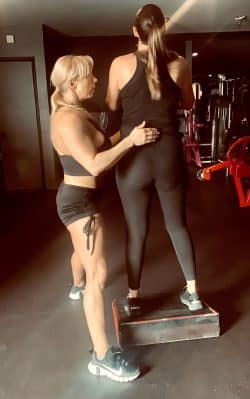
Craig, Cara, and Dominique work together. We communicate, share observations, discuss what we are seeing, and bring our different backgrounds, experience, and perspectives together to help move each client toward their goal.
Craig Tinnelle has more than 30 years of experience in the fitness industry. Cara Barnes has well over 15 years of experience. Dominique Nelson brings approximately eight years of experience. And Physiques Gym has been serving the Phoenix community for more than two decades.
That means when you train here, you benefit from three experienced professionals working together to help you succeed.
One coach may notice something another coach wants to build on. One may have a different cue that helps a movement finally click. One may recognize that a program needs to progress, while another may see that it needs to pull back.
That collaboration is intentional.
We do not believe coaching should happen in a vacuum.
You are not hiring a personality. You are gaining a coaching team.
Experience Matters Because People Are Different
Thirty years of coaching does not simply mean you have memorized more exercises. It means you have seen more situations.
Different bodies. Different limitations. Different personalities. Different goals. Different setbacks. Different ways people learn.
That experience becomes especially valuable when someone walks into the gym saying, “I haven’t exercised in 15 years,” “My knees bother me,” “I’m scared I’m going to hurt myself,” “I don’t know what I’m doing,” or “I just want to feel strong again.”
Those are very different people.
They should not receive identical programs.
At Physiques Gym, our job is to figure out where you are starting and help you move forward from there.
Frequently Asked Questions About Strength Training After 40
Is 40 too late to start strength training?
No. You can begin strength training well beyond your 40s. The important part is starting at a level appropriate for your current fitness, experience, and abilities and progressing from there.
How many days a week should I lift weights after 40?
There is no single ideal number for everyone. Many people can make meaningful progress with two or three strength-training sessions per week, while more experienced lifters may train more frequently. Your goals, schedule, experience, and recovery should guide the program.
Is strength training better than cardio after 40?
They serve different purposes. Strength training helps develop and maintain muscle and strength, while cardiovascular exercise develops aerobic fitness and endurance. Most people benefit from some combination of both.
Do I have to lift heavy weights to build muscle after 40?
You need enough resistance to challenge the muscle, but “heavy” is different for every person. Proper technique, progression, effort, and consistency matter more than chasing a particular number.
Can strength training help with belly fat after 40?
You cannot choose where your body loses fat. Strength training can be part of an overall fat-loss strategy by helping maintain or build muscle while nutrition, activity, and overall energy balance influence fat loss.
What if I have never been in a gym before?
That is exactly what coaching is for. You do not need to know how to use the equipment or understand exercise programming before you start. We can teach you.
Train for the Body You Want to Keep
At some point, fitness becomes less about proving what you can do today and more about protecting what you want to be able to do tomorrow.
That is where strength training becomes powerful.
Yes, it can help change your body. Yes, it can support weight-loss goals. Yes, it can help you build muscle.
But it can also help you stay strong enough to keep doing the things that make your life your life.
That is a goal worth training for.
Physiques Gym is a private training facility in Phoenix, Arizona. We train people. That is what we do.
We are not trying to be a medical clinic, a wellness spa, or a big-box gym. We coach. We teach. We train. And we work together as a team to help our clients move toward their goals.
Whether you want to lose body fat, build strength, gain muscle, improve your fitness, or simply feel more capable as you get older, we will meet you where you are and help you build from there.
You do not need to already be strong to start strength training. You just need a place to start.